Flux's AI agent is now up to 10x faster and self-corrects in real time, delivering cleaner schematics with less waiting and fewer wasted credits.
This blog explores the powerful Arduino map() function, showing you how to scale values, control sensors, and master advanced programming techniques for innovative projects.
The Arduino map() function is a versatile and widely used tool for scaling numbers from one range to another. Whether you're a beginner or an experienced Arduino enthusiast, understanding how this function works and how to use it effectively is crucial for optimizing your projects. In this blog, we’ll cover everything from what the map() function does to practical examples and advanced tips for its use.
map() Function?At its core, the map() function takes an input number within a specific range and maps it to an output number within a different range. This is especially useful when working with sensors, where raw data needs to be converted into meaningful values like temperature, distance, or percentage.
The syntax for the map() function is straightforward:
The function calculates the mapped value using this formula:
map() Function?In Arduino projects, raw sensor data often needs to be scaled for meaningful interaction. For example:
Using the map() function simplifies your code and reduces errors that can arise from manually calculating scaled values.
A common use case for the map() function is reading the input from a potentiometer and converting it to a different range. Here’s an example:
This code reads the raw analog value from a potentiometer and maps it to a percentage (0-100%). This is ideal for applications where you want to control brightness, volume, or other scaled parameters.
map() FunctionServo motors usually operate within a range of 0 to 180 degrees. If you're using a joystick with an analog output, you can map its range (0-1023) to match the servo's range:
The map() function can be used to adjust the brightness of an LED using PWM. Here’s an example:
map() FunctionHandle Out-of-Range Values: The map() function does not automatically constrain input values to the defined range. For safety, you can use the constrain() function:
Floating-Point Mapping: The map() function only works with integers. For floating-point precision, you can implement a custom version:
Inverse Mapping: You can reverse the input and output ranges to invert the mapping. For example, map 0-1023 to 255-0 for inverting brightness:
map()map() for Nonlinear Scaling: The map() function only provides linear scaling. For exponential or logarithmic scaling, you need custom formulas.The Arduino map() function is a simple yet powerful tool that enhances the flexibility and functionality of your projects. From controlling servos to scaling sensor data, its applications are vast and varied. By mastering its use and understanding its limitations, you’ll be well-equipped to handle a wide range of Arduino projects.
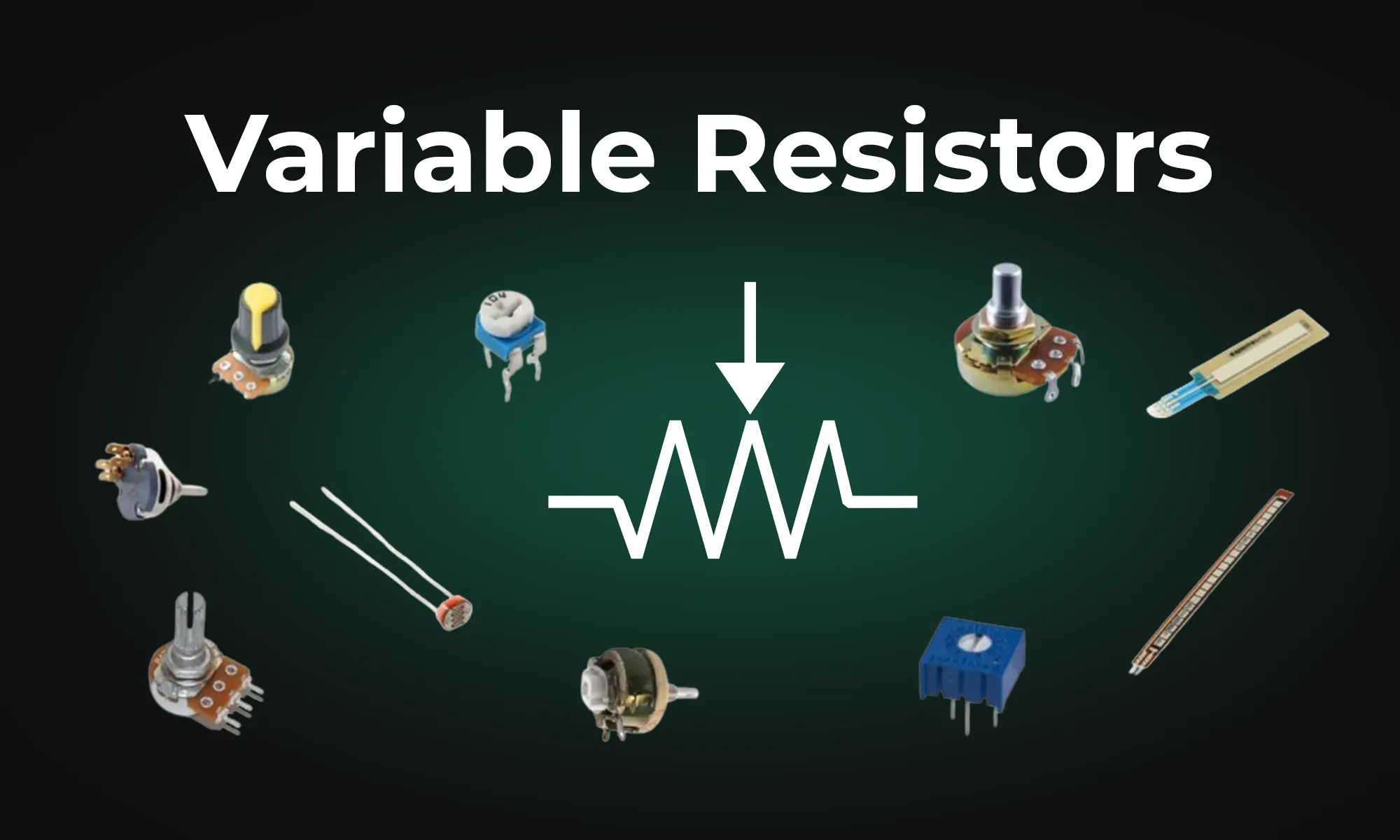
This article provides an overview of six types of variable resistors, including potentiometers, rheostats, photoresistors, wirewound resistors, thermistors, and varistors, highlighting their unique uses in electronic circuits. It also covers advanced applications and emerging technologies like digital potentiometers and memristors, emphasizing their significance in electronic control and adaptability.
Potentiometers, often referred to as "pots," enable fine control of resistance by using a dial or sliding element. The resistive element of a potentiometer can be adjusted using a wiper, controlled by turning a knob. Along with the “wiper” terminal, potentiometers have two additional terminals, typically referred to as “input” and “output” terminals. Two common types of potentiometers are linear and rotary. Linear potentiometers find use in applications like volume control on audio devices, while rotary potentiometers are employed in settings requiring rotational adjustment, such as tuning radio frequencies. They come in various forms, including carbon film and metal oxide variants.
Rheostats are specialized variable resistors designed with only two terminals. While potentiometers are used to control voltage, the primary use of rheostats is to control current in a circuit, adjusting electrical resistance as needed. The two terminals are connected in series with a load (e.g., a light bulb or motor). Adjusting the position of a wiper along the resistance wire changes the resistance in series with the load, thus controlling the current. Common applications of rheostats include dimmer switches for lights and motor speed control.
Photoresistors, also known as light-dependent resistors (LDRs), are two-terminal resistors that change in response to light levels. An LDR exhibits a decrease in resistance as light intensity increases, enabling it to sense and react to environmental light changes. This property makes an LDR ideal for applications like automatic lighting control and light-sensitive alarms.
Wirewound resistors, constructed by winding a resistive wire around an insulating core, are known for their precision and ability to handle high power levels. Although having both fixed and variable variations, variable wirewound resistors allow for the length of the resistance wire included in the circuit to change, altering the resistance. Wirewound resistors also have two terminals. Wirewound resistors are used in applications that demand precise resistance values, such as in precision instruments and high-power electronic circuits.
Wirewound resistors come in both precision and power varieties. Precision wirewound resistors offer high accuracy and low tolerance, making them suitable for applications like voltage dividers and precision amplifiers. Power wirewound resistors are built to withstand high power levels, ensuring they can maintain their resistor value under challenging conditions, making them suitable for high-current circuits and power amplifiers.
Thermistors are temperature-sensitive resistors with two terminals that exhibit changes in electrical resistance with temperature fluctuations. They are classified into two primary types: negative temperature coefficient (NTC) and positive temperature coefficient (PTC). NTC thermistors decrease resistance with increasing temperature, while PTC thermistors exhibit the opposite behavior, making them essential in temperature control systems, such as thermostats, and are vital for temperature compensation in various electronic circuits.
Varistors, also known as voltage-dependent resistors or VDRs, are specialized two-terminal variable resistors designed to protect electronic circuits from voltage spikes and surges. They exhibit a high electrical resistance under normal conditions but rapidly decrease their resistance when exposed to excessive voltage. This behavior allows varistors to shunt excessive voltage away from sensitive components by allowing high current to flow through the varistor instead. Varistors find use for surge protection in electronic systems.
To provide a quick reference, here's a table summarizing these six types of variable resistors:
Voltage dividers are circuits that divide an input voltage into smaller output voltages usually using resistors. Variable resistors, and especially potentiometers, are useful components in creating variable voltage divider circuits. By adjusting the resistance, you can finely control the output voltage.
Variable resistors are at the heart of electronic control and adaptability, and understanding their diverse types and applications is a vital step toward becoming proficient in electronics.
The blog post dives into the technical aspects of Multilayer Ceramic Capacitors (MLCCs), highlighting their importance in electronic circuits. It explains the construction of MLCCs, where layers of ceramic material and metal electrodes create a multilayered structure to store electrical energy.
At its core, a multilayer ceramic capacitor is a passive component that stores electrical energy in an electric field. Its construction involves layers of ceramic material, typically composed of barium titanate, sandwiched between metal electrodes. These layers, when stacked, create a multilayered structure, hence the name.

The dielectric material used in MLCCs significantly influences their performance and Capacitance–which can range from a few picofarads to several microfarads. This flexibility in capacitance makes MLCCs versatile components that can be tailored to meet the diverse needs of electronic circuits. Common dielectric materials include C0G, X7R, and X5R, each offering distinct properties that cater to specific applications.
C0G, also referred to as NP0, is a dielectric material that contributes to the stability of multilayer ceramic capacitors (MLCCs). C0G is a class I dielectric material. The primary composition of C0G dielectrics is typically a mix of finely ground paraelectric materials. The most common material used is titanium dioxide (TiO2), which is often mixed with additives like magnesium titanate (MgTiO3) or calcium titanate (CaTiO3). These materials are chosen for their stable electrical properties and minimal variation in capacitance with temperature.
Temperature Coefficient of Capacitance (TCC): C0G MLCCs are renowned for their minimal temperature coefficient of capacitance (TCC). The TCC of C0G is near-zero, signifying that the capacitance remains nearly constant across a wide temperature range, making C0G capacitors ideal for stable capacitance under the required temperature.
C0G has minimal dependence on applied voltage. This ensures that the capacitance remains consistent even under varying voltage levels.
C0G capacitors exhibit low dielectric losses, indicating minimal dissipation of electrical energy as heat, crucial for applications where efficiency and signal integrity are critical.
X7R and X5R are dielectric materials widely used in MLCCs, offering a balance between versatility and size efficiency. X7R and X5R are class II dielectrics. These materials are predominantly based on a ferroelectric material, barium titanate (BaTiO3). To achieve the desired dielectric properties, various dopants and additives are introduced, such as magnesium oxide (MgO), yttrium oxide (Y2O3), and zirconium oxide (ZrO2). The addition of these dopants helps in modifying the grain structure and electrical properties of the barium titanate, tailoring it for specific capacitance and temperature coefficient requirements. X7R and X5R materials are engineered to offer a compromise between high capacitance values and stability over a broad temperature range.
While not as temperature-stable as C0G, X7R and X5R materials are well-suited for applications where a balance between size, cost, and performance is essential.
The incorporation of additives in X7R and X5R dielectric materials allows these capacitors to achieve higher capacitance values in smaller physical sizes. This is advantageous for applications where space efficiency is a priority, and a higher capacitance is required.
X7R MLCCs find widespread use in applications where a balance of size, capacitance stability, and cost-effectiveness is crucial. Common applications include power supply filtering, coupling and decoupling, and general-purpose signal conditioning.
These capacitors are commonly employed in consumer electronics, such as smartphones and tablets, where space constraints and performance are equally critical.
In environments demanding precision and stability, C0G MLCCs shine. These capacitors are often chosen for high-frequency applications, RF circuits, and critical timing elements where deviations in capacitance can have significant repercussions on performance.
Multilayer ceramic capacitors are available in both leaded and surface-mount device (SMD) configurations. Leaded MLCCs have protruding leads for through-hole mounting, offering ease of manual assembly. SMD MLCCs are designed for automated assembly processes, contributing to the miniaturization of electronic devices.
While MLCCs dominate the capacitor landscape, tantalum capacitors deserve a mention. Tantalum capacitors offer high capacitance density and reliability, making them suitable for applications where space is at a premium and extended operational life is crucial.
The dielectric material used in an MLCC is a critical factor influencing its performance. Engineers must carefully consider the trade-offs between precision, size, and temperature stability when selecting C0G, X7R, or X5R variants.
ESR is a measure of the opposition a capacitor presents to the flow of alternating current. Low ESR is crucial in applications where high-frequency performance is paramount, such as in power supply decoupling.
Leaded MLCCs offer simplicity in manual assembly, while SMD variants contribute to automated assembly processes, enabling efficient mass production.
Researchers are actively exploring methods to increase the capacitance density of MLCCs. One avenue of exploration involves advancements in materials engineering, seeking new dielectric formulations to push the boundaries of capacitance values with an emphasis on maintaining stability across a broad temperature range. Additionally, researchers are investigating techniques to optimize the stacking of ceramic layers within MLCCs, aiming for more efficient use of space without sacrificing performance.
Additive manufacturing, such as 3D printing of capacitors, is being investigated for its potential to create intricate structures that optimize electrical properties.
The blog offers an in-depth look at Zener diodes, highlighting their crucial role in voltage regulation and stability in electronic circuits. It covers their basic principles, applications, and the challenges faced in their usage.
The Zener diode distinguishes itself from ordinary diodes through its ability to regulate voltage. At its core lies the pn junction, where the anode, a p-type semiconductor, meets the cathode, an n-type semiconductor. This junction allows current to flow readily from the anode to the cathode but restricts flow in the opposite direction, a fundamental diode characteristic. However, when the voltage drop across the Zener diode exceeds Vz, it permits reverse current flow, thus acting as a voltage regulator.
To identify a Zener diode, you can look for the following characteristics:

The Zener diode's capacity to stabilize voltage is harnessed by connecting it in reverse bias across a load. When the voltage drop across the Zener diode reaches Vz, it enters a breakdown mode, conducting and maintaining a constant voltage at its terminals, effectively regulating the output voltage (Vout).
A Zener diode works in reverse bias because it is designed to allow current flow when the reverse voltage exceeds a certain threshold, known as the Zener voltage. This occurs due to the Zener effect and avalanche breakdown, where a strong electric field causes electron movement across the diode's junction, enabling current flow in the reverse direction and making it useful for voltage regulation.
To ensure the Zener diode operates within safe current limits, a series resistor is introduced in the circuit. This resistor, positioned between the input voltage source and the anode of the Zener diode, plays a critical role in limiting the current to prevent damage due to excessive power dissipation.
When incorporating Zener diodes into voltage regulation applications, engineers must consider parameters such as Vz, power dissipation, and the maximum current (Iz) the diode can handle. Zener diodes are specifically engineered to sustain a stable Vz, which is vital for maintaining a consistent Vout.
Zener diodes are adept not only at maintaining DC voltage levels but also at preserving the integrity of waveforms in AC circuits. They are instrumental in clipping waveforms to a certain voltage level, providing a stable reference voltage that is crucial in many electronic applications.
Practical application of Zener diodes as voltage regulators involves integrating them into circuits with consideration for both their voltage regulation capabilities and their thermal properties.
In any Zener diode-based voltage regulation circuit, the series resistor is vital. It not only defines the current flowing through the cathode of the Zener diode but also influences the voltage drop across the diode, playing a decisive role in the effectiveness of voltage regulation.
A Zener diode in the role of a voltage regulator must dissipate heat efficiently to maintain its performance and longevity. Engineers must provide appropriate heat sinking and consider the power rating of the Zener diode to mitigate the risk of overheating.
Zener diodes serve as voltage regulators in various applications, from simple voltage stabilization tasks to protecting against voltage transients. They ensure that Vout remains constant, a critical function in many power supply circuits.
In overvoltage protection circuits, Zener diodes safeguard sensitive electronics. They are connected across critical components where they clamp the voltage drop, absorbing and dissipating the energy of voltage spikes, thus protecting the cathode from overvoltage conditions.
In signal processing, the Zener diode provides a stable reference voltage for comparators or analog-to-digital converters (ADCs), ensuring signal fidelity and consistency.
Despite their robustness, Zener diodes encounter challenges such as thermal management and voltage tolerance that can impact their role as voltage regulators.
Thermal instability is a significant challenge in the use of Zener diodes. Excessive heat can lead to failure, making it imperative to manage the thermal conditions within which the Zener diode operates, ensuring the cathode does not exceed its maximum temperature threshold.
The manufacturing variances in Zener diodes can lead to a tolerance in Vz, affecting the precision of voltage regulation. Engineers mitigate this by selecting diodes with tight tolerance levels or by implementing calibration techniques in the final circuit design.
To ensure the Zener diode operates within safe current limits, a current-limiting series resistor may be introduced in the circuit. This resistor, positioned between the input voltage source and the anode of the Zener diode, plays a critical role in limiting the current to prevent damage due to excessive power dissipation.
Zener diodes are indispensable for voltage regulation, offering reliability and precision in electronic circuits. From the atomic interactions within the pn junction to the macroscopic applications in voltage stabilization, these components ensure that electronic devices operate within their designated voltage parameters. Their continued relevance in electronic design underscores their significant role as voltage regulators in an ever-evolving technological landscape.
Think you're familiar with the push button and its symbol? Prepare to be surprised! Join us in our latest blog post where we unravel the intricate science behind every press, click, and circuit, revealing the complexities hidden in the simplicity of a push button switch.
A push button switch is a simple yet versatile electrical switch used to open or close an electrical circuit by pressing a button. These switches come in various shapes and sizes, but they all share the same fundamental principle: pressing the button changes the switch's state from open to closed or vice versa. This action, often accompanied by a satisfying click, completes or breaks an electrical path, enabling or disabling a device's function.

Understanding how a push button switch works requires a closer look at its internal components. Here is a simplified breakdown:
Push button switches can vary significantly in their configurations, and understanding these distinctions is crucial when designing electronic circuits. Here are some common types:
The SPST push button switch is our first type of single pole switch. It is the simplest type, featuring only one set of contacts—ideal for basic on/off functions and is often found in household light switches.
An SPDT push button switch, another single pole switch type, offers two sets of contacts, allowing it to act as a toggle switch between two different electrical paths. This is useful in scenarios where you need to choose between two actions with a single button press.
DPST push button switches have two sets of contacts, each operating independently. They are commonly used in situations requiring two separate circuits to be controlled simultaneously.
Push button switches can be further categorized as latching or momentary. Latching switches maintain their state after being pressed, while momentary switches return to their original state when released. These distinctions are important depending on the intended function of the switch.
One common issue with push button switches is debouncing. When you press or release a button, it can create rapid fluctuations in the electrical signal due to the mechanical nature of the switch. This bouncing generates a series of electrical spikes and dips, making it challenging for the connected circuitry to interpret the intended input accurately. Debouncing is the process of filtering out these erratic signals to ensure a clean and stable transition between states. Achieving this involves employing techniques such as:
In scenarios where users might rapidly press a button, it's essential to filter out unintended or extraneous signals. This can be achieved through electronic circuitry that detects and ignores rapid successive button presses, ensuring that only intentional inputs are registered. Here's how it works:
Pull-up and pull-down resistors play a crucial role in pushbutton switch circuits, especially in microcontroller-based designs. These resistors are used to ensure that the input signal to the microcontroller is in a known state when the button is not pressed.
We see pull-up and pull-down applications in software as well when we set default values or states for variables, flags, or configuration options—specifying how a particular variable or option should behave when it is not explicitly set.
Push button switches find applications in various domains:
In electronic schematics, push button switches are represented using specific symbols. The most common symbols for push buttons include:

Whether you're turning on a light, starting your car, or operating heavy machinery, push button switches play a crucial role. Understanding their science and functionality is essential for anyone working with electronic circuits. So now next time you press that unassuming button, you can understand the intricate science behind it.
Electronics, whether in a phone or an industrial motor, face potential threats from unchecked electrical currents. Our guide introduces protection circuits, the essential safeguards that monitor and respond to such electrical anomalies.
At its core, a protection circuit is a combination of electronic components strategically designed to monitor and respond to abnormal electrical conditions within a circuit. These conditions can include overcurrent, short circuits, overload current, overvoltage, inrush current, and more. By swiftly detecting and mitigating these issues, protection circuits help prevent damage to electronic components and ensure the safety and longevity of your equipment.
Before we dive deeper into protection circuits, let's understand the threats they guard against:
A protection circuit incorporates various components to effectively protect against overcurrent, short circuits, and overload current.
Circuit breakers are the first line of defense in many protection circuits. They are automatic switches that can be triggered to interrupt the flow of current when overcurrent, short circuits, or overload current are detected. Circuit breakers come in different types, including thermal, magnetic, and electronic, each suitable for specific applications.
As the name implies, dedicated short circuit protection devices are designed to rapidly detect and respond to short circuits. These devices often utilize a combination of inductors, diodes, transistors, and other components to redirect or limit the current when a short circuit occurs.
To guard against overcurrent and overload current, protection circuits may incorporate components such as resistors, capacitors, and inductors. These components help control the flow of current and protect sensitive components from damage.
Overvoltage protection is essential for defending against voltage spikes and transients. Components like varistors and specialized diodes are commonly used to absorb excess voltage and prevent it from reaching sensitive components.
Let's take a closer look at some of the mentioned common components used in protection circuits and understand their roles in safeguarding your electronics:
Let's examine how a protection circuit operates in a practical scenario:
Consider an industrial motor starter system, a critical component in many industrial processes. This system comprises motors, control circuits, and power supplies. Ensuring its protection is crucial.
Protection Measures:
In the world of electronics, protection circuits are essential for ensuring the safety and durability of electronic devices. Overcurrent, short circuits, overload current, and other electrical anomalies are persistent threats that can lead to costly downtime and equipment damage.
To safeguard your electronics effectively, implement a well-designed protection circuit with components like circuit breakers, resistors, capacitors, inductors, diodes, and varistors. Customize your protection circuit to suit the specific needs of your equipment and application.